How to choose a custom PHP development company: The 2026 guide
Choosing the wrong PHP development company can cost you thousands in wasted development and forced rewrites. The right partner, however, builds software that scales with your business for years to come.

Key takeaways
- Choosing the right PHP development company means evaluating technical expertise, industry experience, development process, and long-term partnership potential, not just hourly rates.
- Choosing on price alone often leads to problems. For example, a startup hired a $25/hour offshore team and, after six months and $40,000, ended up with a mess it couldn't use. They ultimately spent much more to rebuild it. Short-term savings can result in costly rewrites.
- Everyone says they are "PHP experts," but that tells you almost nothing. Look beyond the portfolio to understand their technical philosophy, testing practices, and post-launch support.
- Generic web development experience doesn't translate to specialized industries. Ask: "Can you show me a similar project you've built? What compliance challenges did you face?"
- Don't skip on automated testing. While it may increase initial development time by 15-30%, it reduces long-term bug fixes by 40-60%.
- Invest in a 1-2 week discovery phase. Proper planning prevents $50,000 in wasted development.
- Don't ignore post-launch maintenance. PHP versions reach end-of-life, introducing security risks.
- Legacy PHP applications don't need risky "big bang" rewrites. Use an incremental migration strategy, prioritizing high-value features first while keeping your system running.
If you’re evaluating custom PHP development companies, you’re likely working with one of these scenarios:
- Building an MVP that needs to scale without a complete rewrite
- Modernizing a legacy PHP system that's become unmaintainable
- Developing a complex application with strict compliance requirements
- Choosing between multiple companies with similar promises
This guide covers everything you need to evaluate PHP development companies and make an informed decision, from technical evaluation criteria to modern architecture patterns to watch for.
What You’ll Learn:
- How to evaluate PHP development companies
- Modern PHP architecture patterns for 2026
- Common mistakes when hiring
- Real costs and ROI considerations
- 8 critical questions answered
Why modern PHP development matters
PHP powers over 76% of websites with known server-side languages. But there is a big difference between legacy PHP 5.x applications and modern PHP 8.x with proper architecture.
The risk: Hiring a company stuck in 2010 patterns means you’ll inherit technical debt from day one.
The opportunity: Modern PHP development with Domain-Driven Design, clean architecture and API-first patterns creates scalable, maintainable software.
Looking for a PHP development partner? See how 25+ years of PHP expertise translates into scalable architecture. Explore our PHP development services.
Evaluating PHP development companies
Technical expertise depth
Here's the thing about evaluating PHP developers: everyone says they "know PHP," but that tells you almost nothing. You need to dig deeper and ask about their philosophy and approach.
Start with their framework philosophy. If a company says "we only work with Laravel" or "Symfony is always the answer," that's a red flag. You want to hear: "We choose frameworks based on project requirements. For rapid MVP development with common patterns, Laravel excels. For enterprise applications needing maximum flexibility, Symfony or framework-agnostic PHP makes sense." This matters because rigid framework choices force your requirements into their preferred tool, which rarely works out.
Next, ask about domain-driven design. This separates professionals from amateurs. Ask: "How do you structure applications to keep business logic independent of framework code?" They should explain separating domain logic from infrastructure concerns. If they look confused or say "we just use the framework's structure," look elsewhere.
Here's what good code looks like versus bad code. The bad approach mixes business logic with framework code:
// Bad: Business logic mixed with framework
class OrderController extends Controller {
    public function create(Request $request) {
        $order = new Order();
        $order->user_id = auth()->id();
        $order->save();
        Mail::to($order->user)->send(new OrderConfirmation());
    }
}
The good approach keeps your business logic framework-independent:
// Good: Framework-independent business logic
class PlaceOrderService {
    public function execute(PlaceOrderCommand $command): Order {
        $order = Order::place(
            customerId: $command->customerId,
            items: $command->items
        );
        $this->orders->save($order);
        $this->email->sendOrderConfirmation($order);
        return $order;
    }
}
Why does this matter? When the next Laravel or Symfony versions is released, framework-coupled code requires expensive rewrites. Framework-independent business logic just works.
Ask about modern PHP features. Specifically: "Are you using PHP 8.x features like attributes, named arguments, and union types?" If they're still using PHP 7.x patterns or seem unaware of PHP 8 improvements, that's a red flag. You want developers who can demonstrate specific PHP 8.x features they leverage and explain why they use them.
Their testing strategy reveals everything. Ask: "What's your approach to testing? Unit, integration, end-to-end?" If they say "we test everything manually before launch" or "we'll add tests later," walk away. What you want to hear is: "We write unit tests for business logic, integration tests for critical workflows, and end-to-end tests for key user journeys. We aim for 80%+ coverage of business logic." Without automated tests, every code change risks breaking something. Yes, testing adds 20-30% to initial development time, but it saves 40-60% in bug fixes long-term.
Industry-specific experience
Generic web development experience does not translate to specialized industries. Healthcare compliance (HIPAA) is more than encryption; it includes audit logs, access controls, business associate agreements, and breach notification procedures. Payments require proper processing architecture, tokenization, and security testing. E-commerce requires knowledge of inventory systems, order processing, payment reconciliation, and fraud prevention. SaaS needs multi-tenancy patterns, billing systems, usage tracking, and subscription lifecycle management.
Ask: "Can you show me a similar project you've built? What compliance challenges did you face?" If they claim expertise in all industries without case studies, that is a red flag. Look for specific examples with details about compliance requirements, challenges, and solutions.
Project portfolio evaluation
Review their past work critically. Look for complexity indicators such as the number of third-party integrations, data volume handled, user scale, and compliance requirements met.
Ask: "What was the most challenging technical problem you solved on this project?" Listen carefully.
You want to hear about specific technical challenges, not tight deadlines or changing requirements. They should describe the problem, the solution, and the trade-offs.
If their portfolio is full of identical websites or simple CRUD applications and you need a complex system, they may lack the experience.
Modern PHP architecture patterns
Understanding these patterns helps you evaluate whether a company is building for the long term.
Domain-Driven Design (DDD)
Most PHP applications tightly couple business logic with framework code. When frameworks update or you need to switch, you face expensive rewrites. Domain-driven design separates core business logic from infrastructure. This is a game-changer.
What should you look for in proposals? Mentions of "domain layer" or "business logic layer," separation of concerns, framework-agnostic code, and ports and adapters patterns. For example, a commercial cleaning company's booking system built with DDD migrated multiple framework versions over 7 years with zero changes to business rules. We just updated the infrastructure layer.
Event-driven architecture
Modern PHP applications use events to decouple components. The traditional approach looks like this:
function processOrder($order) {
   $order->save();
   $this->chargePayment($order);
   $this->updateInventory($order);
   $this->sendEmail($order);
   $this->notifyWarehouse($order);
   // If email fails, everything stops
}
The event-driven approach is much cleaner:
function processOrder($order) {
   $order->save();
   event(new OrderPlaced($order));
   // Individual listeners handle the rest independently
}
The benefits are huge: you can easily add new actions without modifying existing code, individual components can fail without breaking the entire flow, and testing is simpler because you test each listener independently.
Ask them: "How do you handle complex workflows with multiple steps?" You want to hear about events, queues, and asynchronous processing.
API-first development
Building applications as APIs from day one provides flexibility you'll appreciate later. The same backend can serve web, mobile, and third-party integrations. You can change frontend frameworks without touching the backend. Exposing controlled APIs for customers is easier.
Ask: "How do you structure frontend and backend?" The answer you want: “We build a RESTful or GraphQL API first, then consume it with the frontend. This lets us easily add mobile apps or partner integrations later.”
Strangler fig pattern for migrations
Legacy PHP applications need modernization but can't afford downtime or risky "big bang" rewrites. The strangler fig pattern gradually replaces old systems. A proxy layer routes requests between old and new systems. You migrate one feature at a time, test in production with real traffic, and remove the old codebase once everything is migrated.
Ask: "How would you approach modernizing our legacy system?" If they say "we'll rebuild it from scratch in 6 months," that's a red flag. What you want to hear:
We'd use an incremental migration strategy, prioritizing high-value features first while keeping your system running.
Using this pattern, we migrated a legacy payment platform built in 2014 from PHP 5.6 to PHP 8.3 with zero downtime over 4 months.
Common mistakes when hiring

Mistake #1: choosing based on price alone
Going with the cheapest bid to save money upfront is tempting, but it backfires. Cheap developers often lack experience try to maximize profit margins. Cutting corners on testing leads to bugs in production. Poor architecture requires expensive rewrites. Security vulnerabilities create legal and reputational risks.
Here's a real example, a startup hired a $25/hour offshore team for their MVP. After 6 months and $40,000, they had unmaintainable code, end of life PHP version from day one and lots of security issues. They spent multiples of that after that to rebuild it. The better approach? Evaluate based on total cost of ownership, not just initial development cost.
Mistake #2: no discovery phase
"We know what we want. Just start building." This is how projects go off the rails. Hidden complexities emerge during development, scope creep happens, budgets get blown, and premature architectural decisions create technical debt.
Invest in a 1-2 week discovery phase that includes detailed requirements documentation, technical architecture planning, risk assessment, and accurate estimates based on real analysis. Yes, it costs $3,000 to $10,000. But it prevents $50,000 in wasted development.
Mistake #3: ignoring post-launch maintenance
"Once it's built, we're done." This thinking creates problems. PHP versions reach end of life, creating security risks. Third-party APIs change and break your integrations. Security vulnerabilities get discovered in libraries you depend on.
Real example: a healthcare platform launched successfully, but didn't budget for maintenance. After 18 months, they were running on PHP 7.4 (end-of-life with security vulnerabilities), their Stripe integration broke when Stripe deprecated v2, and they had no monitoring, so issues were discovered only when customers complained. Budget 5-10% of the initial development cost annually for maintenance.
Mistake #4: skipping automated testing
"Manual testing is good enough." No, it isn't. Regressions become common, and old bugs keep returning. Fear of changing code develops because you might break something. Bugs are discovered in production instead of development.
Testing initially adds 15-30% to development time, but reduces bug fixes by 40-60% in the long run. Require testing as part of development from day one.
Mistake #5: poor requirements communication
Vague requirements like "build a system like Uber but for X" lead to disaster. Developers make assumptions that don't match your expectations. Missing features are discovered after launch. Your budget gets exhausted before key functionality is complete.
Write detailed user stories. Create wireframes for key screens. Document business rules and edge cases. Prioritize features into must-have versus nice-to-have categories.
Cost and ROI considerations
Factors affecting cost include feature complexity and number, third-party integrations, compliance requirements, custom design versus templates, and testing and quality assurance.
ROI considerations
Automating manual processes often saves 10-40 hours per week per employee. At $50/hour, that's $26,000 to $104,000 per year for a single employee. Manual data entry errors cost 20-30% in rework, automated systems eliminate these costs. SaaS tools that charge per user become expensive at scale, while custom solutions have fixed costs.
Here's a real ROI example, if a commercial cleaning company spends $150,000 on custom management software and they save 15 hours per week in scheduling ($39,000/year), 10 hours per week in invoicing ($26,000/year), reduced missed appointments by 20% ($50,000/year in recovered revenue), and improved quality tracking that increased retention by 15% ($120,000/year). Total annual value: $235,000. Payback period: 7.6 months.
Getting started: step-by-step
- Define Your Requirements (1-2 weeks). What problem does this solve? What does success look like? Who are the users? List your core features, nice-to-have features, user roles and permissions, and integration requirements. Document expected traffic and usage, performance requirements, and security and compliance needs.
- Research and Shortlist (1 week). Create a shortlist of 3-5 companies based on relevant portfolio work, positive client reviews (check Clutch.co), appropriate company size, and time zone compatibility.
- Initial Consultations (1-2 weeks). Prepare questions: Have you built something similar? What's your development process? How do you handle requirement changes? Can you provide references? Evaluate their responses for insightful questions about your business, clear technical explanations, and realistic expectations about timelines and challenges.
- Discovery Phase (1-2 weeks). Invest in proper discovery to get detailed requirements documents, technical architecture plans, accurate timeline and cost estimates, and risk assessments. Why pay for discovery? You get accurate estimates instead of guesses, aligned expectations, and reduced risk.
- Development in Phases. Phase 1 is your MVP (8-12 weeks) with core features that prove business value, scalable architecture, and key integrations. Phase 2 is ongoing enhancement based on user feedback, performance optimization, and new integrations.

Simple applications take 2-3 months, medium complexity projects take 4-6 months, and complex enterprise systems take 6-12+ months. The timeline depends on feature complexity, integrations, compliance requirements, team size, and the clarity of requirements. A realistic MVP timeline is 8-12 weeks for focused core features.
Absolutely. PHP powers 76%+ of websites, including WordPress, Shopify, Facebook, Slack, and Etsy. Modern PHP 8.x offers performance comparable to Node.js and Python, strong typing and modern language features, a mature ecosystem with proven scalability, and a large talent pool that makes hiring easier. PHP isn't dying. It's evolving. Companies that dismiss it miss out on cost-effective, scalable solutions.
Laravel is best for rapid development with common patterns. It has the largest community and gets you to market quickest. Symfony is best suited for enterprise applications that require flexibility and long-term stability. Plain PHP is best for maximum control and framework independence. Our recommendation? Use Laravel for most projects unless you have specific reasons not to, but keep your business logic framework-independent using domain-driven design.
WordPress with plugins offers fast setup, lower cost, and a familiar admin interface, but you get limited customization, performance issues at scale, and security vulnerabilities in plugins. Custom development gives you complete control, optimized performance, and an exact fit to requirements, but costs more upfront, takes longer to develop, and requires technical maintenance. WordPress is best for content-heavy websites, blogs, and simple e-commerce. Custom development is best for SaaS platforms, complex business logic, regulated industries, and unique workflows. A hybrid approach works well too: use WordPress for content (blog, marketing pages) and custom PHP for application logic (user dashboards, complex features).
Essential security practices include input validation and sanitization, SQL injection prevention with parameterized queries, XSS protection through escaped output and CSP headers, strong authentication with bcrypt or Argon2 plus 2FA and RBAC, HTTPS everywhere, regular updates to your PHP version and dependencies, and security testing through automated scanning and penetration testing. Work with developers who follow the OWASP Top 10 guidelines, perform security audits, and have HIPAA or PCI DSS compliance experience.
Monthly tasks include monitoring error logs and performance, and reviewing security alerts for dependencies. Quarterly work includes updating your PHP version and packages, optimizing performance based on usage patterns, and reviewing documentation. Annual maintenance means major version upgrades, security audits, penetration testing, and disaster recovery testing. Budget 5-10% of the initial development cost annually for proper maintenance.
Yes, using the strangler fig pattern for zero-downtime migration. The process involves assessing your current application, planning a migration strategy (which features to migrate first), implementing a proxy layer between old and new systems, migrating incrementally, feature by feature, and completing the transition once everything is migrated. The timeline is typically 3-12 months, depending on the application size. Cost runs 40-70% of building new from scratch. The benefit is continuous operation with reduced risk.
Choose SaaS when your requirements fit existing solutions 90%+, you need to launch quickly (within weeks), you have limited technical resources, you're using standard workflows, or your budget does not allow it. Choose custom development when you have unique requirements SaaS can't meet, regulatory compliance needs demand custom controls, long-term cost efficiency matters (especially with high user counts), you need a competitive advantage through proprietary software, or you have complex integrations with existing systems. A hybrid approach works too: use SaaS for commoditized functions like email and payments, and custom development for unique business logic.
Conclusion
Choosing the right PHP development company comes down to evaluating technical expertise, industry experience, development process, and the potential for a long-term partnership, not just comparing hourly rates.
Modern PHP is powerful. With PHP 8.x, domain-driven design, and proper architecture, PHP applications scale to millions of users. Evaluate thoroughly, look beyond the portfolio to understand their technical philosophy, testing practices, and post-launch support. Invest in discovery. That $3,000 to $10,000 in proper planning prevents $50,000 in wasted development. Plan long-term by budgeting for testing, maintenance, and ongoing optimization. Short-term savings lead to expensive rewrites. Demand framework independence; your business logic should survive framework changes.
Resources for PHP developers: What to learn when AI writes the code
We send this list to every developer who interviews with us, including the ones we say no to. If someone spend…

We deliver outcomes, not code.
Why we hire problem solvers, not order takers, and what actually matters now that AI can write the code.

ThinkWeb at TechArena 2026
Last week, our CEO Theodosios Kariotis and CTO Goce Bonev represented ThinkWeb at TechArena 2026 in Stockholm,…

Why early software estimates are wrong
In software development, the numbers given early are usually wrong. Not slightly wrong, but sometimes by month…
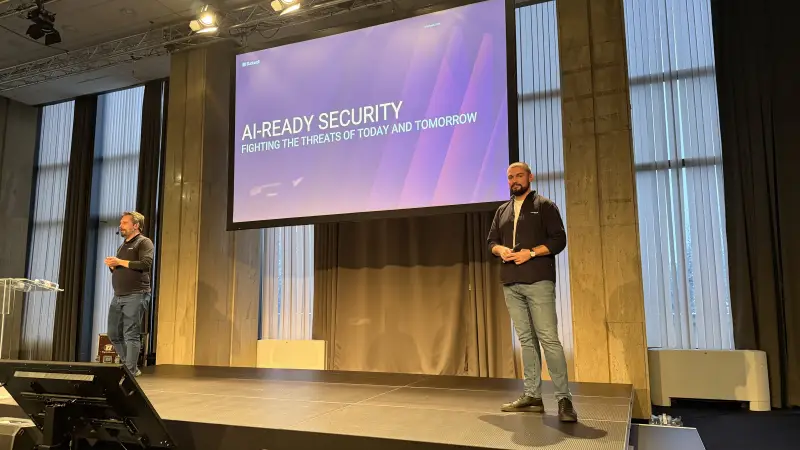
Discussing AI-ready security at WordCamp Sofia
Robert Jacobi, CXO at Blackwall, and Goce Bonev, CTO at ThinkWeb, joined the stage at WordCamp Sofia to talk a…
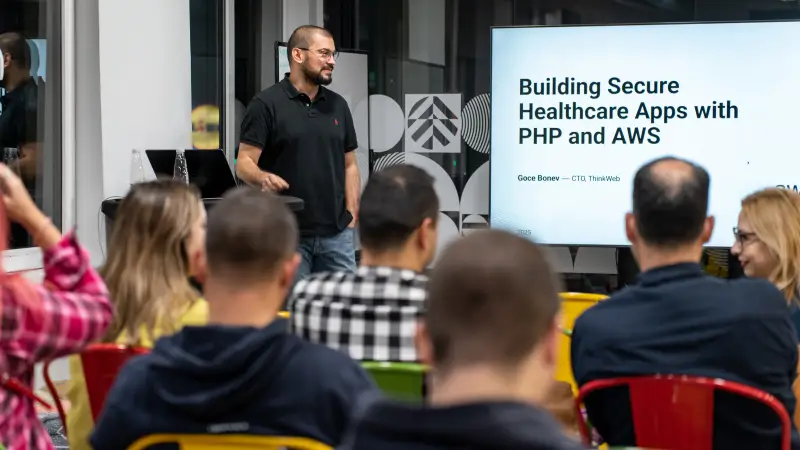
How to build secure healthcare applications with PHP and AWS
Goce Bonev, CTO at ThinkWeb, presented a practical guide to building healthcare applications with a high level…