Why early software estimates are wrong
In software development, the numbers given early are usually wrong. Not slightly wrong, but sometimes by months. Early estimates are based on assumptions rather than facts. At that stage, key details are still unclear, dependencies are not fully understood, and real constraints have not yet been discovered. Once development starts, reality challenges these assumptions. We see this pattern repeatedly across software projects, technology stacks, team sizes, and industries. It is far less common in off-the-shelf product implementations.


Key takeaways
Software estimates can be off by months because they rely on assumptions instead of facts. In the beginning, no one fully understands the scope, how integrations actually work, or what condition the data is in.
Surprises show up late, third-party APIs that don't work reliably, more complex user roles, compliance requirements nobody mentioned, and old data that needs cleanup. Even the idea of being "done" is based on assumptions. For some, it just means the software runs. For others, it means a production system with security, testing, and monitoring in place.
Giving an estimate too soon creates a false sense of certainty. Budgets and deadlines are set based on it, which can lead to rushed choices, silent scope cuts, or disagreements about what was promised.
Estimates only become reliable after the discovery phase. That’s why we begin by defining goals, risks, and constraints, then update the estimate as the scope gets clearer.
Clients frequently ask, “Can you give us an estimate and a timeline?” This question often arises early, sometimes after only a brief call or email. From a business perspective, this is reasonable, as budgets and activities require planning and alignment.
Over the last 15+ years, we have worked on more than 140 custom systems, from internal platforms to regulated healthcare and financial software. Many of these systems remain in use and continue to evolve years after their initial release. Often, these projects started with a short brief and changed significantly once discovery began and real constraints, dependencies, and requirements became clear. In regulated industries such as healthcare or insurance, the uncertainty is higher because compliance and security requirements depend on the system context, which must be validated during discovery.
What is an estimate
It is a prediction based on assumptions. These include scope, users, workflows, integrations, data quality, security and compliance requirements, performance expectations, and operational constraints. If these are unclear, the estimate is built on unstable ground. An estimate also assumes that key decisions exist or that there is agreement on how they will be made.
"Done" is another problematic assumption. For some, it means something that runs; for others, it means a production grade system that is secure, tested, monitored, and ready to operate. If these expectations differ, the estimate is already wrong. This is why early estimates often vary by multiples, not percentages. The uncertainty at the start compounds.
| Early assumption | What it affects | What can go wrong |
|---|---|---|
| The scope is mostly clear | Core functionality | Important features surface late and stretch the timeline |
| Users will work like this | Workflows and UX | Real usage forces redesign after development has started |
| Integrations are simple | External systems | APIs are limited, unstable, or behave differently than expected |
| The data is fine | Migration and reporting | Extra work appears around cleanup, mapping, or missing data |
| Decisions will be fast | Planning and delivery | Waiting on approvals quietly extends timelines |
The house example
If you ask a builder, “How much does a house cost?” the honest answer is "It depends". A two-bedroom house can vary in cost depending on foundations, materials, location, heating, permits, and other decisions. Software development projects are the same. Two with identical short descriptions can differ by months once the real requirements are known.
Why early estimates fail
Early estimates often fail because unknowns surface later in the discovery process. This is not a mistake; it is the nature of software.
In one of our projects, the estimate was based on data models and API documentation provided upfront. The integration appeared straightforward. When development began, it became clear that the data was incomplete and the external APIs were unreliable. The workflows that were planned to run synchronously had to be reworked into asynchronous processes so users could complete the flow reliably.
The resulting timeline and budget shift was not caused by delivery issues, but by a mismatch between documented assumptions and how the external systems behaved.
This difference between documentation and real system behavior is not unusual. Some examples we regularly see include:
- Third-party integrations that are undocumented or unreliable
- User roles and permission models that grow in complexity
- Security, privacy, or regulatory requirements discovered late
- Legacy data that needs cleanup or migration
- More stakeholders involved than initially expected
None of these are rare cases. They are common in real systems, especially in healthcare, finance, e-commerce, and internal business platforms.
The cost of guessing
An estimate creates a sense of certainty. Budgets are approved, deadlines are announced, and expectations are set. As development progresses and time or cost begins to diverge, friction between the parties appears. The estimate becomes the reference, not the assumptions behind it.
| Early assumption | Typical outcome |
|---|---|
| Optimistic timeline | Pressure to rush decisions or skip quality work |
| Low initial budget | Hidden scope cuts or constant renegotiation |
| Vague scope | Disputes about what was included |
| Decisions will be fast | Approval and decision making add weeks to timelines |
At that point, the problem is no longer technical; it becomes a trust issue and starts damaging the relationship. Giving a number we do not stand behind, even with good intentions, creates expectations that reality will later contradict. From there, every delay feels like a failure and every adjustment feels like an excuse. What began as an optimistic guess starts to look like a broken commitment. That is not how a long-term partnership should begin.
We prefer to be honest early, even if that means saying "we do not know yet." It is a better starting point than giving a number that looks certain but is not.
How we approach estimation at ThinkWeb
We do not treat estimation as a single promise made early. We treat it as a gradual reduction of uncertainty. In practice, this means starting with conversations about goals, not features. We look for technical and organizational risks early, then use discovery and scoping to make assumptions visible. As scope and constraints become clear, estimates become more precise. As the system evolves, we revisit them.
This approach aligns with established discovery-first and risk-reduction practices used by mature engineering teams.
At ThinkWeb, we build our software development services around clarity first. That applies whether we are working on custom PHP development, healthcare platforms, e-commerce systems, integrations, or modernizing legacy software.
Before we can commit to timelines or budgets, we need to understand the real business problem and what success looks like. We look at user workflows, map system boundaries and integrations, and plan for security, privacy, and compliance requirements early.
What we can and cannot do early
Early conversations should be about understanding, not committing. When we say "we do not know yet", it is sometimes misunderstood as uncertainty or lack of experience. In practice, it shows the opposite.
When you have worked on complex systems, you know how quickly early assumptions break. Because of that, we are careful about where we commit and where we do not.
What we can do
- Discuss feasibility and constraints at a high level
- Identify major risks early
- Help shape the problem before implementation
- Advise on priorities and trade-offs
What we will not do
- Commit to fixed timelines without a defined scope
- Provide precise budgets based on assumptions
- Compete on who can guess the lowest number
This is a boundary we keep deliberately. It protects the project and the relationship.
When estimates become reliable
Estimates align with reality once uncertainty is reduced. After thorough discovery, we understand what is being built and why. At that point, estimates become more precise and useful for planning.
| Project Stage | Estimate Reliability |
|---|---|
| Idea or short brief | Very low |
| After discovery | Moderate to high |
| During delivery | High, with small adjustments |
A better first conversation
Instead of beginning with numbers, it is better to start with questions such as:
- What problem are we solving?
- Who is this system for?
- What does success look like?
- What constraints actually matter?
This approach is how we protect delivery, budgets, and trust across all our projects. For more information see our development process.
Whether you have a clear plan or just an idea, we’re here to listen, advise, and help you move forward. Reach out to explore how custom software can support your business goals.
Resources for PHP developers: What to learn when AI writes the code
We send this list to every developer who interviews with us, including the ones we say no to. If someone spend…

We deliver outcomes, not code.
Why we hire problem solvers, not order takers, and what actually matters now that AI can write the code.

ThinkWeb at TechArena 2026
Last week, our CEO Theodosios Kariotis and CTO Goce Bonev represented ThinkWeb at TechArena 2026 in Stockholm,…

How to choose a custom PHP development company: The 2026 guide
Choosing the wrong PHP development company can cost you thousands in wasted development and forced rewrites. T…
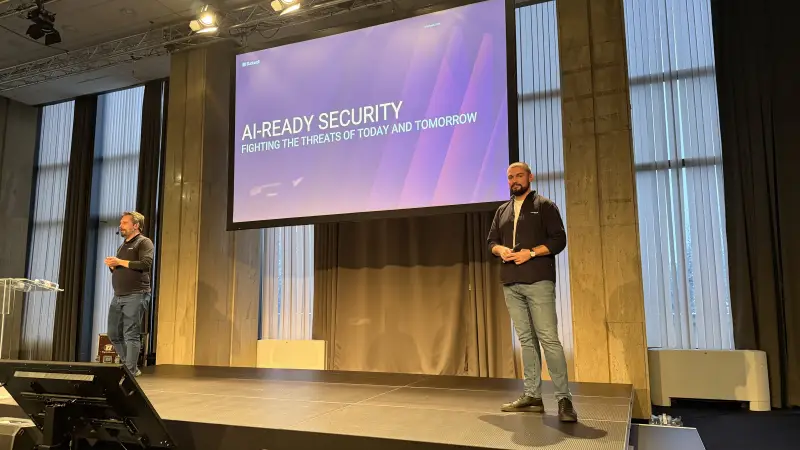
Discussing AI-ready security at WordCamp Sofia
Robert Jacobi, CXO at Blackwall, and Goce Bonev, CTO at ThinkWeb, joined the stage at WordCamp Sofia to talk a…
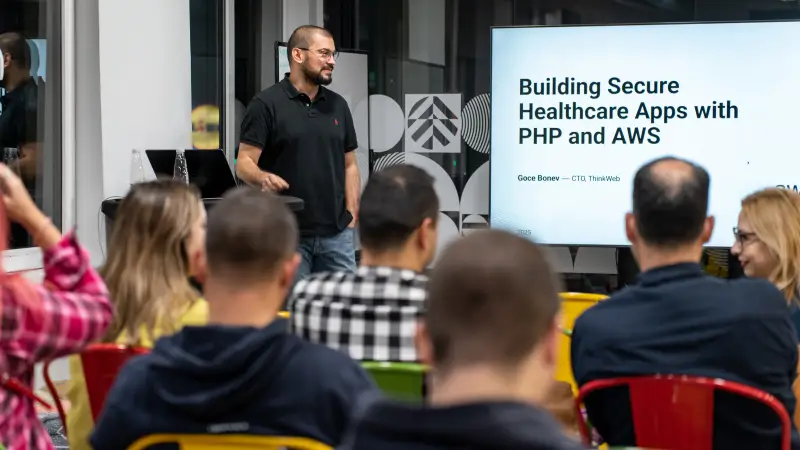
How to build secure healthcare applications with PHP and AWS
Goce Bonev, CTO at ThinkWeb, presented a practical guide to building healthcare applications with a high level…